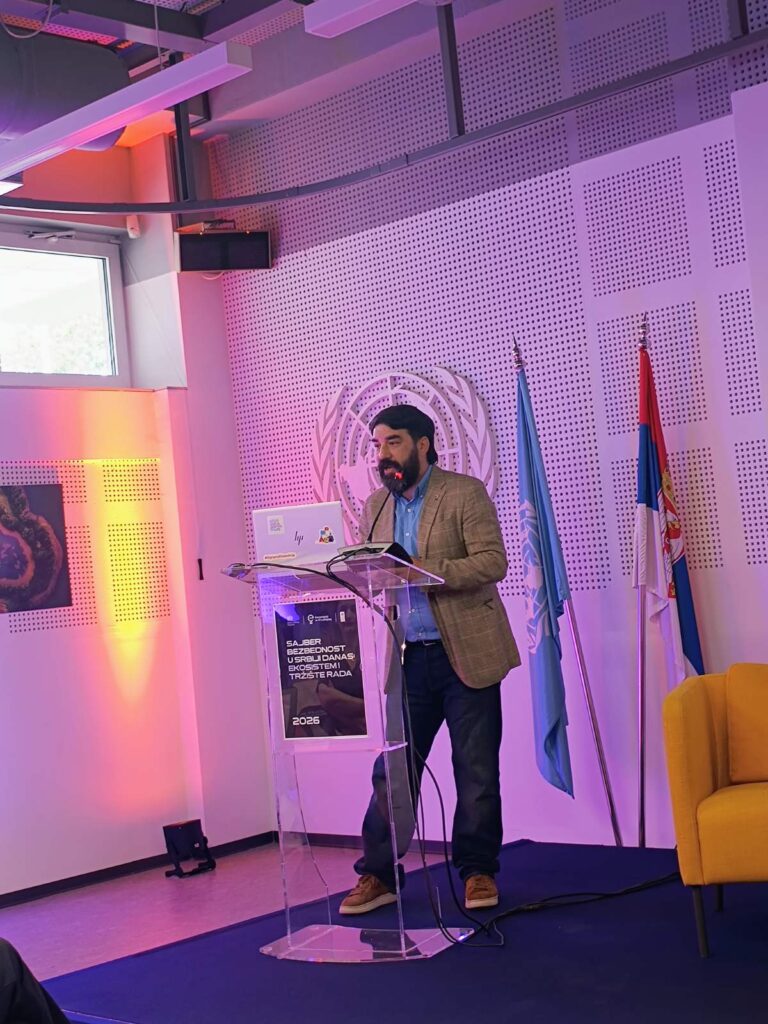
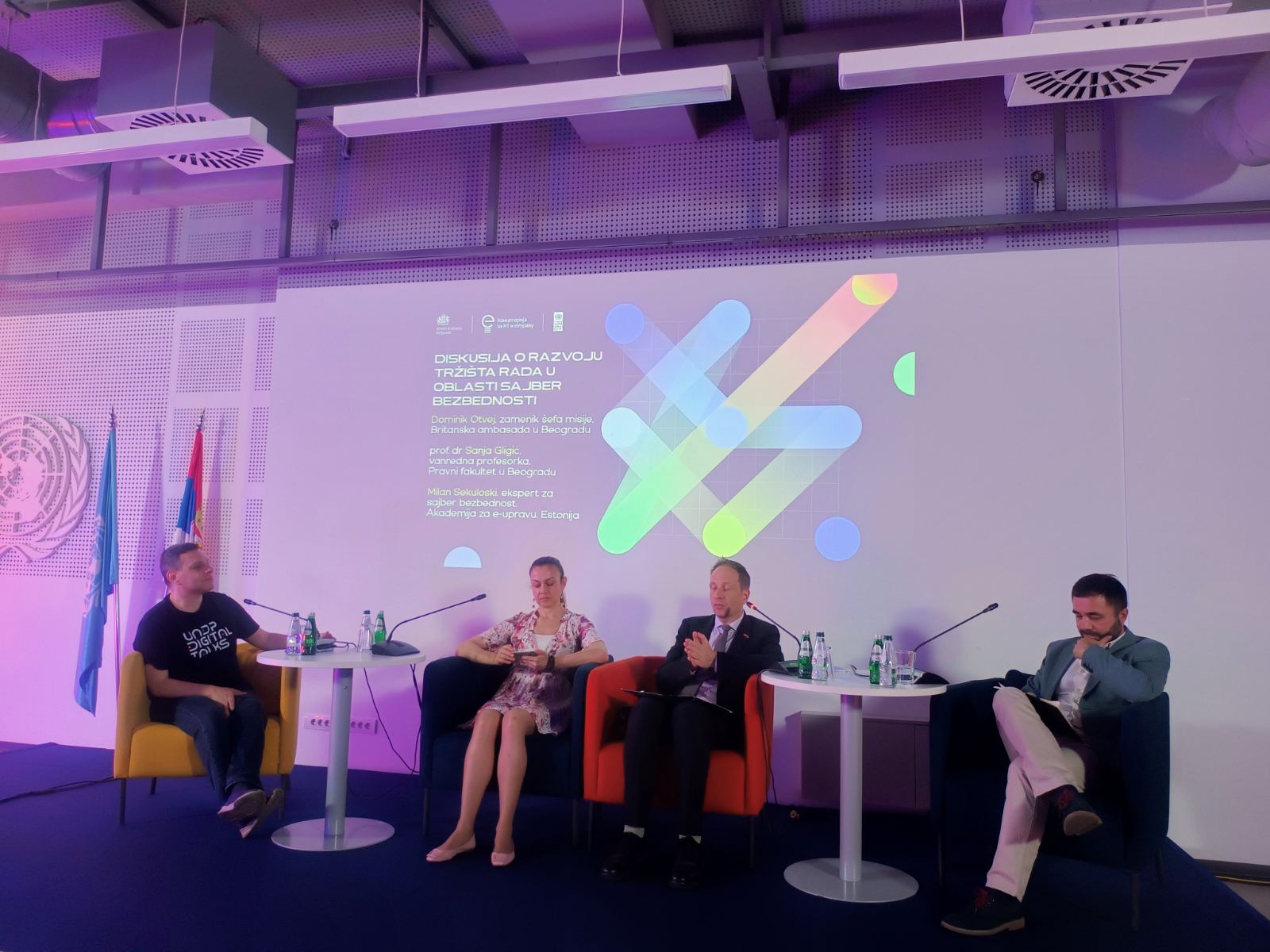
Belgrade, June 2, 2026 – The event “Cybersecurity in Serbia Today: Ecosystem and Labour Market” brought together representatives of government institutions, international organizations, academia, and the private sector to discuss the current state and future development of cybersecurity in Serbia.
Hosted at the UN House in Belgrade, the event marked the presentation of one of the most significant initiatives for Serbia’s cybersecurity community to date – the country’s first comprehensive Cybersecurity Ecosystem Map.
Opening remarks were delivered by Jakup Berish, UNDP Resident Representative in Serbia, H.E. Edward Ferguson, British Ambassador to Serbia, and Dr. Mihailo Jovanović, Director of the Office for IT and eGovernment.
The speakers emphasized that cybersecurity has become a critical pillar of national resilience, economic development, and digital transformation. They highlighted the importance of international cooperation, investment in cybersecurity talent, and strengthening cyber resilience across public and private sectors.
Mapping Serbia’s Cybersecurity Landscape
The centerpiece of the event was the presentation of the Cybersecurity Ecosystem Map of Serbia, introduced by Prof. Dr. Đorđe Krivokapić from the Faculty of Organizational Sciences.
For the first time, the interactive platform brings together key stakeholders from across Serbia’s cybersecurity sector, including companies, startups, government institutions, regulators, CERT teams, educational institutions, civil society organizations, international partners, and support programs.
According to the findings presented:
- 840 ecosystem entities have been mapped;
- More than 1,536 relationships and connections have been identified;
- Over 180 organizations were analyzed in detail.
The platform provides a unique visualization of how cybersecurity stakeholders interact and collaborate, offering valuable insights into the structure, maturity, and development of Serbia’s cyber ecosystem.
Insights into the Cybersecurity Services Market
Using the taxonomy developed by the European Cyber Security Organisation (ECSO), researchers examined the services offered by organizations operating in Serbia’s cybersecurity market.
The analysis identified nearly 500 cybersecurity services, with the strongest concentration in the Protect category, covering technologies and services focused on securing systems, networks, and data.
The findings suggest that defensive cybersecurity capabilities currently represent the most developed segment of Serbia’s cybersecurity market, reflecting both market demand and the growing maturity of local service providers.
Addressing the Cybersecurity Skills Gap
The event also featured the presentation of the Cybersecurity Labour Market Study, delivered by Adel Abusara, Cybersecurity and Privacy Director at PwC Serbia.
The study explored current workforce trends, talent shortages, recruitment challenges, and future skills requirements within the cybersecurity sector. It highlighted the growing demand for qualified professionals and the need for stronger alignment between education and industry requirements.
A panel discussion dedicated to cybersecurity workforce development followed, bringing together representatives from the UK Government, the Ministry of Education of Serbia, academia, and international experts from Estonia.
Discussions focused on:
- Developing digital and cybersecurity skills;
- Strengthening cooperation between universities and industry;
- Increasing the participation of women in cybersecurity professions;
- Building sustainable talent pipelines to support future growth.
Participants agreed that long-term cyber resilience depends not only on technology but also on people, education, and continuous investment in skills development.
A Strategic Tool for the Future
The launch of Serbia’s Cybersecurity Ecosystem Map represents a major step forward for the country’s cyber community and an important reference point for the wider Western Balkans region.
By providing a structured overview of key actors, capabilities, and relationships, the map creates new opportunities for collaboration, research, policymaking, and ecosystem development. More importantly, it offers a foundation for evidence-based decision-making and future investments in cybersecurity capacity building.
As Serbia continues to strengthen its position as a regional digital leader, initiatives such as the Cybersecurity Ecosystem Map and the Labour Market Study will play an increasingly important role in shaping a secure, resilient, and innovation-driven digital future.
The event was organized as part of the “Strengthening Serbia’s Cyber Resilience” project, implemented by UNDP Serbia in partnership with the Office for IT and eGovernment, with the support of the British Embassy in Belgrade.
——————————————————————————————————————————–
Predstavljena prva Mapa sajber bezbednosnog ekosistema Srbije: važan korak za razvoj domaće i regionalne sajber zajednice
Beograd, 2. jun 2026. – U prostorijama Ujedinjenih nacija u Beogradu održan je događaj „Sajber bezbednost u Srbiji danas: ekosistem i tržište rada“, na kojem su predstavljeni rezultati jednog od najznačajnijih istraživačkih projekata za domaću sajber zajednicu – prve sveobuhvatne Mape sajber bezbednosnog ekosistema Republike Srbije.
Skup su otvorili Jakup Beriš, stalni predstavnik UNDP-a u Srbiji, Nj.E. Edvard Ferguson, ambasador Ujedinjenog Kraljevstva u Srbiji, i dr Mihailo Jovanović, direktor Kancelarije za IT i eUpravu.
U uvodnim obraćanjima istaknuto je da sajber bezbednost danas predstavlja jedan od ključnih temelja digitalnog razvoja, ekonomskog rasta i nacionalne bezbednosti. Govornici su posebno naglasili značaj međunarodne saradnje, razvoja stručnih kadrova i jačanja sajber otpornosti kao naredne faze razvoja digitalnog društva.
Centralni deo događaja bila je prezentacija prve interaktivne Mape sajber bezbednosnog ekosistema Srbije, koju je predstavio prof. dr Đorđe Krivokapić sa Fakulteta organizacionih nauka. Mapa po prvi put na jednom mestu objedinjuje podatke o kompanijama, startupima, državnim institucijama, regulatorima, CERT timovima, obrazovnim ustanovama, organizacijama civilnog društva, međunarodnim partnerima i programima podrške koji čine domaći sajber ekosistem.
Prema predstavljenim podacima, mapirano je čak 840 aktera i identifikovano više od 1.536 međusobnih veza, što pruža jedinstven uvid u strukturu i povezanost cyber zajednice u Srbiji. Analiza je obuhvatila više od 180 organizacija, a poseban fokus stavljen je na usluge koje se nude na domaćem tržištu.
Koristeći metodologiju Evropske organizacije za sajber bezbednost (ECSO), istraživači su identifikovali gotovo 500 različitih sajber bezbednosnih usluga. Rezultati pokazuju da najveći deo domaćeg tržišta čine usluge iz oblasti zaštite sistema, podataka i infrastrukture, što potvrđuje da je segment odbrane i zaštite trenutno najrazvijeniji deo srpskog sajber sektora.
Dr Mihailo Jovanović istakao je da su Mapa sajber bezbednosnog ekosistema Srbije i Studija o tržištu rada važni alati za dalji razvoj nacionalnih kapaciteta i kreiranje politika zasnovanih na podacima.
Pored predstavljanja mape, učesnici su imali priliku da se upoznaju i sa rezultatima Studije o tržištu rada u oblasti sajber bezbednosti, koju je predstavio Adel Abusara, direktor za sajber bezbednost i privatnost u PwC Serbia. Studija je ukazala na rastuću potrebu za kvalifikovanim stručnjacima, izazove u pronalaženju kadrova i značaj kontinuiranog razvoja veština u oblasti sajber bezbednosti.
Posebnu pažnju privukla je panel diskusija posvećena razvoju tržišta rada u sajber sektoru. U razgovoru su učestvovali predstavnici britanske vlade, Ministarstva prosvete Republike Srbije, akademske zajednice i međunarodni eksperti iz Estonije. Diskusija je bila fokusirana na razvoj digitalnih veština, unapređenje obrazovnih programa, jačanje saradnje između univerziteta i industrije, kao i povećanje učešća žena u sajber bezbednosti, gde one trenutno predstavljaju značajno manji deo radne snage.
Jedan od ključnih zaključaka događaja jeste da budućnost sajber bezbednosti neće zavisiti isključivo od tehnologije, već prvenstveno od ljudi, znanja i saradnje između javnog sektora, privrede, akademske zajednice i međunarodnih partnera.
Za sajber zajednicu Srbije, ali i regiona Zapadnog Balkana, predstavljanje Mape sajber bezbednosnog ekosistema predstavlja značajnu prekretnicu. Po prvi put stvoren je alat koji omogućava sistemsko sagledavanje kapaciteta, identifikaciju razvojnih prilika i bolje povezivanje svih relevantnih aktera. Upravo zato ova inicijativa ima potencijal da postane model za razvoj sličnih nacionalnih mapa i u drugim zemljama regiona.
Događaj je organizovan u okviru projekta „Jačanje sajber otpornosti Srbije“, koji UNDP u Srbiji sprovodi u saradnji sa Kancelarijom za IT i eUpravu, uz podršku Britanske ambasade u Beogradu.